Showing posts with label no fun. Show all posts

2011-05-04

one for the road


bron: onbekend, vraag het aan Groen!

Yannick heeft een verslag gemaakt ivm. het colloquium van Groen! "Een moderne kijk op muziekbeleid":

Terwijl er in socialistische kringen nog volop gekaterd werd ter verwerking van de jaarlijkse rode feestdag, besloten ze bij Groen! deze 2de mei nuttig in te vullen met een colloquium over een ''moderne kijk op muziekbeleid." (https://www.muziekcentrum.be/news.php?ID=2509) Op deze manier wil de partij input verkrijgen van de (voornamelijk populaire) muzieksector met betrekking tot een aantal agendapunten inzake popbeleid. Een aantal van de pijnpunten

op de agenda waren de vraag naar meer fiscale hefbomen voor de sector, meer internationale groeikansen voor opkomende muzikanten, een aangepaste regeling voor kleine en middelgrote concertorganisatoren en een meer modern auteursrecht. Wij van netwaves waren van de partij en het was natuurlijk vooral dat laatste wat ons interesseerde.

De verschillende programmapunten werden behandeld in verschillende werkgroepen die in beperkte groep het debat openden rond het euvel in kwestie. In de werkgroep auteursrecht waren het vooral Olivier Maeterlinck van BEA (https://www.belgianentertainment.be/), Luc Gulinck van Uradex (https://www.uradex.be/) en Carine Libert van Sabam (https://www.sabam.be/) die het hoge woord voerden en dit onder het wakend oog van Brussels Parlementslid en moderator van dienst Annemie Maes (https://www.annemiemaes.be/). Het opmerkelijkste punt in de sneuvelnota van Groen! betrof het voorstel om downloaden te legaliseren. Al moeten we die kop met een serieuze korrel zout nemen zo blijkt. Groen! stelt voor om een algemene wettelijke licentie in te lassen, waarvoor juist weten wij na een uur discussi�ren nog steeds niet. Het lijkt alsof ze het niet zo bedoelen dat de illegale downloads gelegaliseerd worden door een algemene taks. Wat wij er dan wel uit verstaan hebben is dat er inderdaad een algemene taks komt, die ze willen aanrekenen aan de serviceproviders, maar dat er nog steeds toestemming van de auteurs nodig is om te mogen downloaden. Daarenboven geeft Groen! grif toe dat ze wel verwachten dat de serviceproviders deze kost wel zullen doorrekenen. Algemene conclusie is aldus dat Groen! een nieuwe heffing op internetverkeer wil invoeren en dat downloaden nog steeds illegaal blijft. Dit zijn natuurlijk extra inkomsten voor de sector, maar of dit ook iets gaat verhelpen aan piraterij of de wezenlijke discussies rond de downloadproblematiek is ons een raadsel.

En ook de rest van de sector stond nogal sceptisch tegenover voorliggende sneuvelnota. Wat wij wel hebben onthouden van dit colloquium is dat de sector vraagt om piraterij effectief aan te pakken en tegelijk het legaal aanbod te promoten en de consument te onderwijzen over het auteursrecht en de alternatieven. En daar zien wij met netwaves een geknipte taak weggelegd voor onszelf. Ook in de toekomst zullen wij blijven pleiten voor meer vrije muziek en zullen wij naar beste vermogen proberen de rest van wereld te onderwijzen over de mogelijkheden van Creative Commons en vrije content. Hopelijk ziet de sector op termijn in dat educatie over een alternatief legaal aanbod bijdraagt aan de sensibilisatie van het illegale en kunnen we alzo met verhoogde steun en input van de sector zoeken naar nieuwe mogelijkheden voor vrije muziek. Als Groen! deze punten zou meedragen in haar volgende inspanningen, moeten we de term 'sneuvelnota' in de toekomst hopelijk niet meer zo letterlijk nemen.

link: https://www.groen.be/agenda/agenda-colloquium-een-moderne-kijk-op-muziekbeleid_336.aspx


2011-04-10

de EU en de muzieklobby

Zweedse Piratenpartij: "Welkom bij de Europese Unie, waar grote lobby-organisaties het meest te zeggen in de Commissie, en waar burgers gemakkelijk genegeerd worden. Het enige echte nieuws is dat ze niet eens meer proberen dat te verbergen."

Bij VPRO's 3 voor 12 vind je een artikel over de aanstelling van Maria Martin-Prat als EU-verantwoordelijke over auteursrechten. Deze Britse was in het verleden hoofd van de IFPI, een grote belangenorganisatie voor de platenindustrie.

Lees het hele artikel: https://3voor12.vpro.nl/artikelen/artikel/44620118
Ifpi: https://www.ifpi.org/


2010-12-06

EMI uses piracy

EMI, one of the gang of four, posted tracks of some of its' artists on the 'piracy haven' RapidShare for marketing and promotion reasons. There is a word for it: hypocrisy.

Read the whole story on Torrentfreak:
https://torrentfreak.com/emi-promotes-music-on-piracy-haven-rapidshare-101204/


2010-11-13

the sound of silence

A mysterious incident occurred with Hazard Records at the Internet Archive:

Hazard: "In august 2008, Hazard Records released the album "This Is The End, Beautiful Friend", by File Under Toner and uploaded it to the Internet Archive. It was made by recording run-out grooves (supposedly silent) of thirty-six selected records and manipulating them both by analogue and digital means. The audible result is a series of thirty-six short tracks of manipulated surface noise.

This record poses a couple of questions: "do the silent run-out grooves have copyrights?" and "in case they have, who do they belong to?". For this reason, it uses records from artists who have been involved in copyright infringement cases before. It used run-out grooves of records by Abba, Michael Jackson and James Brown, all of them known for suing artists who had used fragment of their works out of context.

At the end of September 2010, the album "This Is The End, Beautiful Friend", by File Under Toner, was "made unavailable" by the Internet Archive due to "issues with the item's content".

So, we have un-censored the record (made it available again) in October 2010. Just to (try to) keep things calm, we have removed (part of) the liner notes and replaced them by the open letter we wrote to the Internet Archive. The original liner notes can still be found in a text file (hopefully invisible for automatic filters). We hope that this is a good solution for this situation. However, it might be a good idea to download the record quickly, just in case."

Link full article: https://www.ankitoner.com/fut/theend_en.htm
Link release: https://www.archive.org/details/hr061
Link rerelease: https://www.archive.org/details/hr061b/


2010-10-24

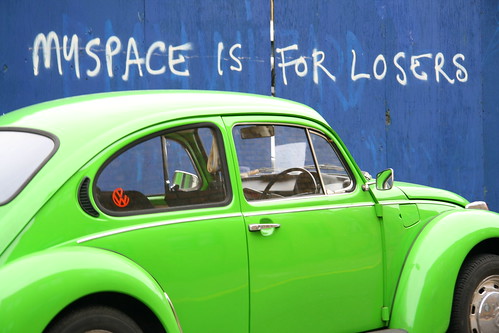
Quit Myspace Day


photo: captain simon's mandolin cc:by-nc

New Music Strategies calls for a massive quitting of MySpace on 24th oct. Netwaves' MySpace page is already more than 1 year in passive mode, and maybe we will quit Rupert Murdoch's shit, but i can't find the delete button. Does anyone know how to quit?

Link: https://www.newmusicstrategies.com/2010/10/23/the-time-has-come-its-quit-myspace-day/
Link netwaves' MySpace: https://www.myspace.com/netwaves

One of the people behind New Music Strategies is Andrew Dubber who wrote a very interesting and must-read book (free pdf) about the music business online:
"The 20 things you MUST know about music online"

An excerpt: "There is also the story about how the internet is �killing� the record industry. Downloading, and the practice of burning CDs is single-handedly responsible for the impending demise of the major labels, causing the decline of high street retail and is undermining traditional, �natural� models of music distribution and consumption � and consequently preventing rights holders from receiving their deserved reward for their part in the creative process.
Nonsense.
In fact, technology does not �cause� these things. Technology changes and we choose our response. We have agency and can negotiate these shifts in media, as long as we understand them as they happen."


Link to download or read: https://www.newmusicstrategies.com/2007/03/16/the-20-things-you-must-know-about-music-online/


2010-07-01

Ascap and the boomerang effect


Read the paper which L. Peter Deutsch, EFF and Ascap member sent to Ascap:

"Dear ASCAP,
I have been a composer member of ASCAP for several years. I was disgusted by your grossly one-sided letter soliciting my contribution to your �Fund for the Arts.� ASCAP has consistently misrepresented the purpose, the history, and the facts of copyright � not to mention the mission and activities of Creative Commons, Public Knowledge, Electronic Frontier Foundation, and other public-interest organizations � apparently in order to fatten its royalty stream deprive musicians of the ability to use each other�s work, and prevent listeners from enjoying music to which the law and the history of copyright entitle them. I recently completed a research paper on music copyright that backed up my reading of this situation.

I have sent a copy of this letter and your letter, and a contribution of $100 each, to Creative Commons, Public Knowledge, and EFF.

Sincerely,
L Peter Deutsch"

via ZeroPaid


2010-06-30

ASCAP declares war on free culture

Monopolising culture? Read about the newest rattle of an outdated industry that wants to claim the role of victim instead of admitting that it is colonizing its resources, ie. artists:

Zeropaid.com: "The free culture movement is abuzz today over news that ASCAP has requested their members to fight organizations like Creative Commons, Public Knowledge and the Electronic Frontier Foundation over what it claims as an effort to undermine copyright."

Quote from the letter (1 & 2 from ASCAP: "�At this moment, we are facing our biggest challenge ever. Many forces including Creative Commons, Public Knowledge, Electronic Frontier Foundation and technology companies with deep pockets are mobilizing to promote �Copyleft� in order to undermine our �Copyright.� They say they are advocates of consumer rights, but the truth in these groups simply do not want to pay for the use of our music. Their mission is to spread the word that our music should be free.�

Anyway, this bomb is looking like being good promotion for Creative Commons, EFF, ea.
:-)

More info at Zeropaid.com: scroll down to the "Who's talking about it?" section.

Via our Dutch friend Marco Raaphorst.


2010-03-31

why music sounds worse nowadays

While supermarkets used to play 'muzak', nowadays they blow me and my caddy away with their overcompressed shit: well, it's good for my wallet.

Click on the image to read an instructive article about 'The Loudness Wars' in npr-music.


full poster of 'A Visual History Of Loudness' by Christopher Clark

2010-03-27

China blocks Archive.org?


On his netlabelsite ZhangJW, who is the netlabel owner of the Bypass Netlabel, wonders aloud if his mother country China blocks the Internet Archive for its citizens. He also notices that his blog which resides on Blogspot/Blogger (owned by Google) is unreachable for himself.

He's afraid things are going the wrong way these days in China: "That's what happend in China. Everyday Chinese people's Internet activity under the control of Golden Shield Project, with stringent surveillance and freedom limited. If you try to type a keyword "BBC news" on google.com and trying to visit the results, well then yours google access will be blocking immediately."

Zhang concludes: " "St. Augustine said "An unjust law is no law at all and, it can thus be no crime to violate" Well, that exactly is what i will going to do."

via noCo...mment

Relisten to netwaves in China (unfortunetaly no Bypass stuff).


2010-01-28

Groen! bakt ze Bruin!

De Vlaamse ecologische partij Groen! wil "Downloaden legaliseren"!: "Senator Freya Piryns heeft samen met haar Ecolo-collega Benoit Hellings een wetsvoorstel ingediend dat tot doel heeft het downloaden op internet voor iedereen toegankelijk te maken en te legaliseren." of hoe Clouseau en dEUS slapend rijk worden zonder een klop te doen, en hoe we eindelijk verlost en bevrijd worden van de bekoring van het illegale downloaden: betaal gewoon, en het wordt legaal. Tip voor criminelen: betaal gewoon voor je illegale daden, en het wordt legaal. Piraten krijgen eindelijk amnestie ... enz...
Ik heb alvast die Freya een mail gestuurd, geef maar commentaar, je mag trouwens de brief kopi�ren en verspreiden en remixen, allemaal legaal en gratis, maar ja, ik ben dan ook geen artiest, tenminste niet ene met een hitje:

- je kan onderwijl een nummertje beluisteren van Les Baudouins Morts "WWW", en dat heeft iets met de Wereldwinkel te maken ... (cc:by-nc-sa) (weeral pikant historisch detail: dit is de eerste belgische aanzet tot dubstep ooit, weliswaar langzaam uitmondend in post-new wave) -

---
Beste Freya,
sinds 2004 probeert ons projekt 'netwaves' de gedachte van open kultuur te promoten, en meer bepaald vrije muziek. Dit is muziek die met de goedkeuring van de auteur mag/kan
worden gedownload, gekopieerd en verspreid via een Creative Commons (CC) licentie (mits naamsvermelding). Dit is gelijkaardig met wat in de computerwereld gebeurt: daar heb je de wereld van gesloten produkten, die als hoofdmotief winstmaken heeft, en je hebt de wereld van de open filosofie, waar winst niet op de eerste plaats komt, maar eerder de gedachte van vrijheid van informatie. De grote voorbeelden daar zijn het softwarepakket OpenOffice, de open browser Firefox, de fotosite Flickr en Picasa die allebei met Creative Commons werken, en Wikipedia, die sinds een half jaar alle artikelen converteert van een Gnu licentie naar die van CC. Zelfs in de academische wereld is er een shift bezig naar 'Open access' documenten.

Sta me toe dat je even mee in de geschiedenis kijkt om het perspectief te begrijpen van waaruit die 'open filosofie' gedachte gegroeid is die bij een deel van de cultuurliefhebbende mensen leeft.

Voor de opkomst van het internet werd de populaire muziek verdeeld door uitgeverijen/platenfirma's die door hun technische exclusiviteit (platenpersen, studio opnames) een quasi monopolie hadden als bevoorrader van muziek bij radio- en televisiestations en later tijdschriften. Een belangrijke bron van inkomsten in veel landen was/is de airplay (betalen per uitzending) en de hitjeskultuur, waarbij op een artifici�le manier de commercie van de muziek werd omhoog gestuwd. Door verdere globalisering van deze uitgeverijen werd de hitjesmuziek een globale melkkoe met meer hitwaarde dan inhoudelijke kulturele waarde, en samen met het blijven herhalen van de hitjesformule was dat mee de oorzaak van een eerste dalende verkoop.
(* zie literatuur beneden).

Rond die tijd verhuisde de term piraterij mee naar het internet. Piraterij ofwel 'illegaal' kopi�ren was al van de tijd van het vinyl toen cassetjes het populaire piratenmiddel waren. Door de opkomst van de computers en het internet kreeg het kopi�ren een massaler karakter, en werd het ook meetbaarder. Maar ondertussen veranderde door datzelfde internet het uitgeverslandschap. Hierbij werden door hun democratische karakter sociale netwerken en blogs belangrijk en in bepaalde gevallen namen ze de taak over van de traditionele uitgevers (kranten, fotografen). Zo ook bij de muziek: meer en meer artiesten die niet met de hitjeskultuur willen meewerken richten een eigen uitgeverijtje (netlabel) op, of releasen hun materiaal op zo'n netlabel. Hierbij komt het conflict van open en gesloten terug naar boven: uitgeverijen konden door het gesloten karakter geld verdienen, maar door het open karakter van het internet verdwijnt een deel van de inkomsten en daarmee hun bestaansreden van winstmaken. We zitten nu op het scharniermoment dat de cd/dvd gaat verdwijnen en daarmee samenhangend de traditionele platenfirma's, en dat er nieuwe organisaties gecre�erd worden die een nieuwe vorm van cultuurverspreiding met of zonder winst gebruiken. Bij de muziek zal dat aan de ene kant netlabels en netaudio communities zijn (bvb. Jamendo, electrobel.be, homerecording.be), aan de andere kant entertainment groepen die de showbizz en optredens verzorgen (Clear Channel die Werchter en Pukkelpop bezit, studio 100).

Belangrijk is nu dat de cultuur, na het decennialange beheer en bezit door de uitgeverijen, dank zij het internet een veel breder platform zou moeten krijgen en een opener karakter, en terug bij de mensen zou moeten komen zonder dat commerci�le belangen primeren. Maar dat de uitgeverijen hun rol nog niet hebben uitgespeeld merken we elke dag aan de media die als het ware worden gekoloniseerd door de oude mogols. Dit hoor je bij het voortdurende credo dat artiesten worden gebroodroofd op hun auteursrechten en winst mislopen door piraterij en illegaal downloaden. De media pikken dit zonder verpinken op, omdat diezelfde media voor dezelfde multinationals werken en door de reklameinkomsten daarvan afhankelijk zijn. Merk echter op dat over piraterij en illegaal downloaden geen wetenschappelijke cijfers bestaan, laat staan over legaal niet-commercieel downloaden.

Het is dan ook ontmoedigend dat politici en opiniemakers hetzelfde credo blindelings volgen in naam van de 'arme artiest', die steeds als ekskuustruus wordt opgevoerd. Vergeet niet dat het in het debat steeds over de winst of verlies van de uitgeverij gaat, en relatief over dat van de artiest, die eigenlijk een 'tombola'-beroep uitoefent (je verdient als je chance hebt). Met relatief bedoel ik dat enkel de bekende artiesten met een BV-status gebaat zijn met auteursrechtelijke bevorderende maatregelen zoals Sabam, Auvibel en een taks op het internet, of zoals Bart Caron, Vlaams volksvertegenwoordiger van Groen! in de Standaard Online van woensdag 19 augustus 2009 zei: "Wie veel gespeeld wordt, krijgt het meest. Zo eenvoudig is dat. En dat is nu toch totaal overbodig? Mattheuseffect heet dat: wie al veel heeft, zal veel krijgen. Er moet integendeel steun gaan naar artiesten die de eindjes moeilijk aan elkaar kunnen breien, of omdat ze minder verkoopbaar werk maken, of vernieuwende muziek maken."

(*) literatuur:
"Creativity and innovation in the music industry" van Tschmuck Peter, te leen in de bibliotheek Economie van de K.U.Leuven
"The 20 Things You Must Know About Music Online" van Andrew Dubber, legaal te downloaden op
https://www.newmusicstrategies.com.php5-2.dfw1-2.websitetestlink.com/wp-content/uploads/2008/06/nms.pdf (pdf)

Ik hoop u met dit, misschien langdradig, epistel een aanzet gegeven te hebben om uw voorstel "Downloaden legaliseren" in een ander perspectief te herbekijken, en vooralsnog dit om te buigen naar een positievere boodschap: "Legale downloads populariseren", zoals ik bescheiden heb proberen te demonstreren op ons Kopiefeest, zie:
https://netwaves.org/node/479

Verder ben ik altijd bereid om met iemand van Groen! hier verder over te informeren en te discussi�ren.
Ondertussen kan u nog bijkomende litereatuur vinden op m'n website:
https://netwaves.org/links/resources
https://netwaves.org/links/literature

Bedankt voor de aandacht.
Groeten,
Michel Berghs
voorzitter vzw. MUP
---

Deze brief is gepubliceerd onder een Creative Commons licentie:
Creative Commons License
Brief aan Groen! by embe is licensed under a Creative Commons Attribution 2.0 Belgium License.
Based on a work at www.netwaves.org.

2010-01-23

Brian Eno on records and blubber

I came accross Andrew Dubber's new music strategies website, and what did i read there!? One of my favorite artists in an interview with the Guardian is exactly telling what i'm thinking, except for the whales thing, i use the horses and cars comparison. Let's hear it from Eno, an artist with roots in the golden seventies-popculture, who is also producer of 2 of the biggest moneymaking bands in western culture: "I think records were just a little bubble through time and those who made a living from them for a while were lucky. There is no reason why anyone should have made so much money from selling records except that everything was right for this period of time. I always knew it would run out sooner or later. It couldn�t last, and now it�s running out. I don�t particularly care that it is and like the way things are going." "The record age was just a blip. It was a bit like if you had a source of whale blubber in the 1840s and it could be used as fuel. Before gas came along, if you traded in whale blubber, you were the richest man on Earth. Then gas came along and you'd be stuck with your whale blubber. Sorry mate � history's moving along. Recorded music equals whale blubber. Eventually, something else will replace it.�� the whole interview via The Guardian

2010-01-21

Dutch trade union wants tax on the internet for musicians

One of the biggest trade unions in the Netherlands, the FNV, wants to deal with the government about a "licence to download". This means, people who use the internet have to pay a contribution for the income that 'poor' musicians will miss out because of piracy. My answer is: expand this to other professions too like software developers, photographers and television makers. I'm quite disgusted because the idea comes from a trade union. These people should make promotion for free music instead of defending capitalist popicons. I say capitalist popicons, because it is clear where these taxes will go to. This is called the Matthew effect.
Read the speech from the FNV speaker.

2010-01-02

artiesten protesteren tegen nieuwe Auvibel-taks


De vernieuwde Auvibel-taks op geluidsdragers (usb-sticks, DVD's, harde schijven, ...) die ingaat op 1 februari, is in het verkeerde keelgat geschoten bij verscheidene artiesten. Als gevolg hiervan heeft homerecording.be een petitie opgestart met een open brief aan minister Van Quickenborne. Laat uw commentaar hier achter op het forum.
De open brief vind je hier, en dit is tevens de offici�le link: men zegge en blogge het verder: https://www.homerecording.be/artikel/open-brief-artiesten-protesteren-zelf-tegen-auvibel-taks.

2009-12-29

nieuwe tarieven op usb-sticks, blanco DVD's, harde schijven

Auvibel, de collectieve beheersvennootschap voor het kopi�ren voor eigen gebruik van geluidswerken en audiovisuele werken - lees: de vergoeding op de thuiskopie - , heeft nieuwe tarieven bekomen, die van toepassing gaan op 1 februai 2010. U betaalt vanaf dan bvb. 0,50 euro op een memorystick van 2Gb tot 16Gb of 9,00 euro op een schijf van > 1 Terabyte. Allez, Clouseau gaat weer blij zijn.
Hier vind je de volledige lijst van nieuwe tarieven.

the pope: all rights reserved!

From the Catholic News Agency: "The Vatican made a declaration on the protection of the figure of the Pope on Saturday morning. The statement seeks to establish and safeguard the name, image and any symbols of the Pope as being expressly for official use of the Holy See unless otherwise authorized."
Read more and read also what The Pravda has to tell about it.

2009-12-08

Chet Baker sues record industry

... or at least his estate, which is part of a massive class-action lawsuit against the 'gang of four' of the Canadian Recording Industry Association: Warner Music Canada, Sony BMG Music Canada, EMI Music Canada, and Universal Music Canada.


Read the article by Michael Geist.


2009-11-23

musicians meet record labels in court


Are we facing a new tendency?: "Soon, though, the major labels are going to have a different copyright battle on their hands -- one that will pit them not against those who want to listen to recordings, but those who created them in the first place. Call it the fight over "Funkytown."
Read more in "IP Law & Business"

2009-11-17

launch of Copyright Watch

EFF says: "The Electronic Frontier Foundation (EFF), Electronic Information for Libraries (eIFL.net), and other international copyright experts joined together today to launch Copyright Watch -- a public website created to centralize resources on national copyright laws at www.copyright-watch.org."

Read the "What is Copyright Watch?".

2009-11-16

short news


- just added Arthena at the basics page: it is the union of all Belgian collecting societies in every creative discipline (music, books, photography, journalism, sculptures, ...)
- good news for people with a ringtone of their favorite band on their mobile phone, EFF reports: "Court Rules That Phones Ringing in Public Don't Infringe Copyright"
- Brussels webradio Bodink reports with an open letter (French) that musicians in Belgium get 4 times more paid on webradios than their German colleagues, thanks to the difference in the payment of airplay by the collecting society Sabam.

2009-08-02

studiedag "Muziek Digitaal"


Op 28 oktober 2009 organiseert Muziekcentrum Vlaanderen i.s.m. het Departement Cultuur, Jeugd, Sport en Media de studiedag "Muziek Digitaal". De studiedag focust op muziek in het digitale tijdperk: hoe be�nvloedt de opkomst van digitale technologie de (re)productie, distributie en consumptie van muziek? De volgende sessies komen aan bod:
- Muziek business models in het digitale tijdperk
- Op zoek naar fans? Over online promotie, marketing en netwerking rond muziek
- En als alles nu eens gratis was? Over auteursrecht in een digitale samenleving
- Music overload?! Hoe reageren muziekliefhebbers op al die nieuwe digitale toepassingen?
- Redden computergames de muziekindustrie?
- Muziek & het mobile web: uitdagingen en opportuniteiten

meer info op de website van 'Muziek digitaal'